

LeBron James is like no other player in NBA history. The career scoring leader set yet another record when he became the first man to play 23 seasons in the league.
The 2025-26 version of James is also like no other previous version of himself. Sciatica forced him to miss opening night for the first time in his career. After sitting out the Los Angeles Lakers' first 14 games, he has shown more inconsistency and a different play style than ever before.
With his 41st birthday just 12 days away, he looks mortal. And he's taking a clearer backseat to teammates Luka Doncic and Austin Reaves for the 18-7 Lakers.
Let's examine how James looks different this season compared to the past two decades -- and what that means for the Lakers, who need an elite version of the future Hall of Famer if they want to contend in a top-heavy Western Conference.
Jump to a topic:
A surprising decline in scoring
A different playing style
His rest-of-season prognosis
James-Doncic-Reaves trio hasn't worked

Fewer points for the career points leader
For just about any other player in NBA history, simply playing into his 40s would be a remarkable accomplishment. Scoring 17.6 points per game would be unprecedented. The previous scoring leader at this age was Kareem Abdul-Jabbar, who averaged 10.1 points in his age-41 season, at the end of a long, gradual aging curve. His last season with at least 24 points per game came when he was 33.
James, in contrast, averaged at least 25 points for 20 consecutive years after his rookie campaign, dipping only slightly to 24.4 last season.
Year-by-year points per game from scoring leaders
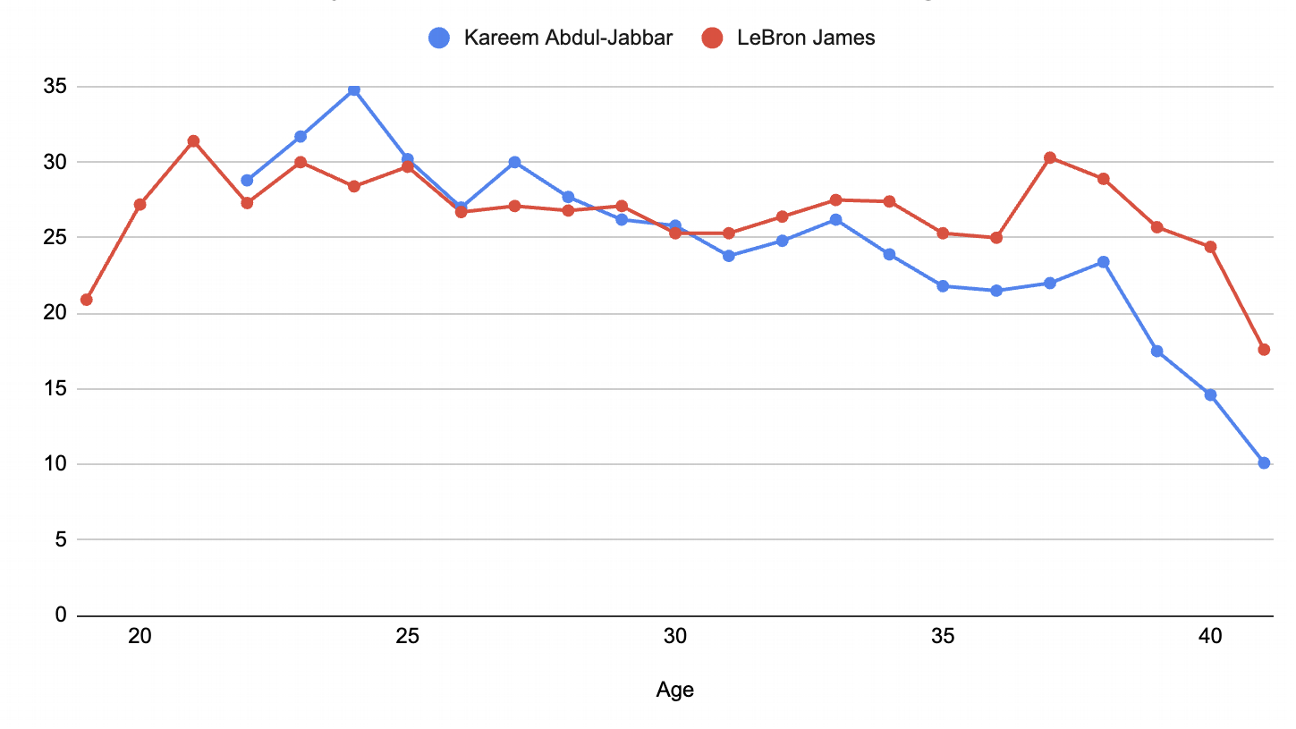
That longevity and consistency helped James pass Abdul-Jabbar on the career leaderboard. The Hall of Fame center scored more points during each player's peak age range, but James got a head start by entering the NBA right out of high school and never really declined -- until now.
James' 6.8 PPG drop is the largest among any of the 47 players who averaged at least 20 PPG last season. (At the same time, Reaves' 7.6 PPG increase is the largest for any 20-point scorer last season.)
A large part of that decline is a deterioration of James' historic consistency. He has three games with at least 20 points this season, but he has also had games with 13, 11, 10 and eight points. That eight-point outing, most famously, ended his record 1,297-game streak of double-digit points in the regular season.
Generally speaking, production in the NBA is a function of efficiency and volume -- and James' scoring downturn is the result of problems on both ends of that equation. GeniusIQ tracks the expected effective field goal percentage for every player in the NBA, based on factors such as shot distance and defender location. And in every season of the tracking era (since 2013-14) until now, James had overperformed his expected eFG%.
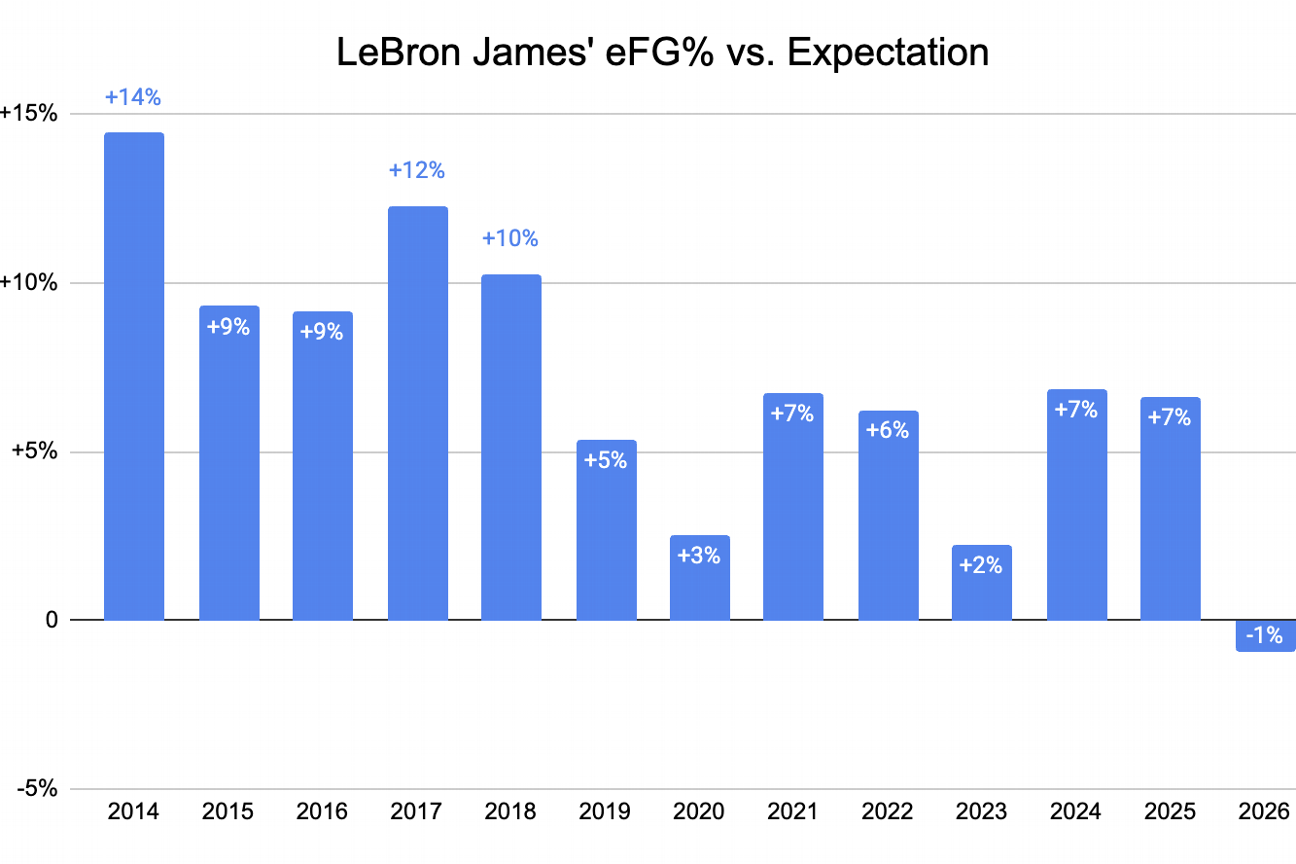
In 2025-26, though, James has slightly underperformed his shot quality for the first time on record.
A different playing style
On top of his efficiency dropping, James is also receiving fewer opportunities to score. In every previous season of his career, his usage rate was at least 28%, and he ranked among the league's top dozen players in each of his first 20 seasons. In his 21st and 22nd seasons, he fell only slightly, to 21st and 14th place, respectively.
But if James had enough playing time to qualify in his 23rd season, he'd rank just 47th with a 24.2% usage rate. He was next to superstars such as Donovan Mitchell, Victor Wembanyama and Stephen Curry on the usage leaderboard last season; now he's among No. 2 options Jerami Grant, Jaren Jackson Jr. and Derrick White.
James has never before driven so little of his team's offense. To wit:
James is touching the ball for 4.32 minutes per 100 possessions, according to GeniusIQ. His previous low in the tracking era was 7.23 minutes; last season it was 7.56. That year-over-year drop is the second largest for any rotation player this season. (The largest belongs to Tyler Herro, now playing in a new offensive system in Miami.)
James has 8.0 drives per 100 possessions, per GeniusIQ, down from 14.5 last season. His previous low was 11.3.
James is using 7.1 isolations per 100 possessions, per GeniusIQ, down from 11.4 last season. He has never been below 9.1 before.
When he's the ball handler, James is receiving 10.7 picks per 100 possessions, down 59% from last season's 26.2, according to GeniusIQ.
The pattern is the same across every play type; basically, every graph of James' usage stats looks like this:
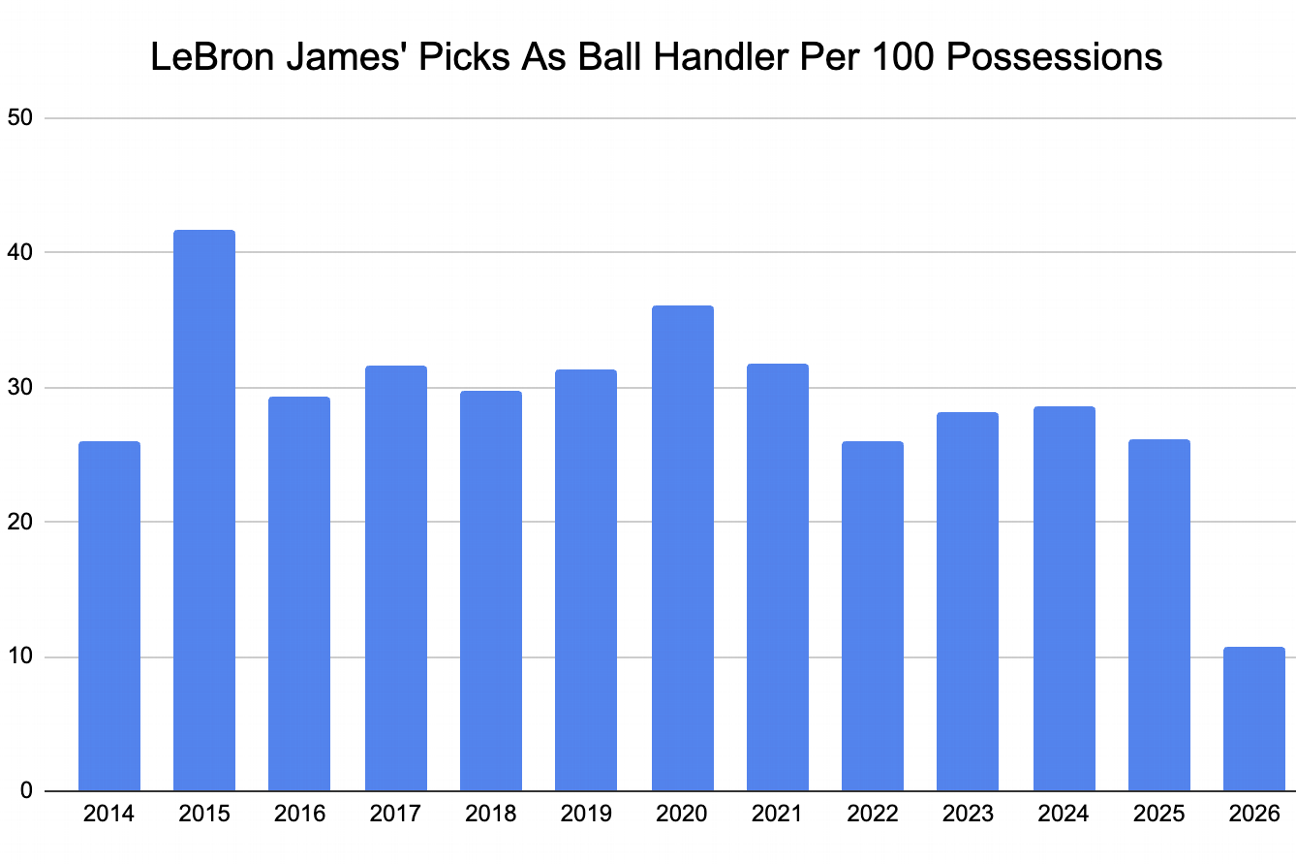
There's some year-to-year variation from the start of the tracking era through last season, but generally tremendous consistency over that span -- especially considering that James aged from 29 to 40 in that time. But then comes the 2025-26 season and a sudden drop-off.
James is still productive and efficient when he does run the offense. He ranks in the 83rd percentile in iso scoring, and in the 92nd percentile on picks. He's just not receiving nearly as many opportunities, instead picking and choosing his spots more than ever before.
James' rest-of-season prognosis
What does this new-look version of James mean for the rest of his -- and the Lakers' -- season? Has Father Time actually caught up to the man who for so long seemed to defy his influence?
The good news for James is his shooting will likely improve as the season continues -- even if not all the way back up to his norms from previous decades. His true shooting percentage is 53.9%, which would represent his worst mark in a full season since he was a rookie, but full-season stats can obscure streakiness in smaller stretches. Within the past decade, James has had worse true shooting marks in nine-game spans in:
March 2025
November to December 2024
December 2023 to January 2024
October to November 2022
December 2019 to January 2020
January to February 2018
February 2016
December 2015
In every previous instance, he emerged from his slump and ended the season just fine. Three of those seasons ended with trips to the NBA Finals. And even though he's dealing with unprecedented age and injury issues, there's no reason to think he can't rebound again in the next several months
For instance, James' free throw percentage is down to a career-low 62%. He missed two technical free throws against Phoenix on Sunday (before making two of three from the line to win the game after a 3-point foul in the final seconds). But it would be exceedingly strange if a career 74% shooter on more than 11,000 attempts suddenly started struggling this badly from the line.
James has also made just 29% of his 3-point attempts. He had hit 37% of his 3-point tries over the past five seasons, and such a sudden, dramatic drop-off is unlikely at the same time he is making a high percentage of his midrange jumpers. Advanced pose data from GeniusIQ shows no glaring changes in James' body measurements that would suggest his legs have abandoned him on his long-range attempts.
Even if James' production might tick back up closer to his career norms, however, his play style has probably changed for good.
Statistics around usage and play types tend to be "sticky" -- meaning, in statistical parlance, that the early trend tends to remain true over time. In other words, don't expect James to start driving and isolating and using dozens of screens per game again.
Here's another data point supporting that theory: Out of nearly 1,000 games James has logged in the GeniusIQ database, he has tallied fewer than five picks just five times. One was in November 2013, one was in the 2023 playoffs, and three have come this season.
That's not a fluke; that's the new normal.
James' influence on the Lakers
Another strong indicator of James' current form and role is what his own coaching staff thinks about him. And there lies a revealing statistic: In games in which James, Doncic and Reaves have appeared together, James hasn't played a single minute without at least one of the two others. Here's the distribution from those seven games, according to PBP Stats:
It makes sense that Lakers coach JJ Redick would structure his rotation with at least two of his big three on the court at all times; indeed, those lineups have accounted for 90% of the Lakers' minutes across these games. (The 10 minutes without any member of the big three were all in low leverage.)
Just last season, Redick generally made sure to stagger Doncic and James after the midseason trade for the former. James played 55 minutes by himself in games with all three creators in 2024-25.
Yet this season, Redick is staggering Doncic and Reaves instead. That's a logical move, given Reaves' star turn and the desire not to foist such a burden on a soon-to-be 41-year-old, but it's still suggestive about James' placement in L.A.'s offensive hierarchy.
The most worrisome part for Los Angeles is that its big three doesn't seem to be working as expected. When James, Doncic and Reaves have shared the court this season, the Lakers have been outscored by 10 points in 132 minutes.
That continues a concerning trend. In the 2024-25 regular season, that trio outscored its opponents by just two total points in 423 minutes. And then the Lakers were blown out in the playoffs, with a minus-24 margin in five games against the Minnesota Timberwolves.
Overall, the James-Doncic-Reaves trio is minus-32 in 695 minutes together. It has a negative-2.2 net rating, according to Cleaning the Glass. James, Doncic and Reaves are less than the sum of their parts.
The defense has unsurprisingly been an issue when the three offensively oriented stars share the court. The Lakers' 120.5 defensive rating in those 695 minutes, per Cleaning the Glass, would place them near the bottom of the overall team rankings.
But the offense is also a reason for concern. The theory of the Lakers' case is that their offense could be so dominant with Doncic, James and Reaves together that it could compensate for any defensive weakness. But instead, the big three's offensive rating is only 118.3 -- a good number, certainly, but far from a dominant one. That's the same as what the Spurs' ninth-ranked offense has done this season.
For comparison, look at another famed trio of star playmakers. In their limited time together in the 2020-21 season, the Brooklyn Nets' Kevin Durant, James Harden and Kyrie Irving had a scorching 129.5 offensive rating -- more than 10 points ahead of the Lakers' big three.
Or look at what Doncic and Reaves have accomplished when playing together without James: a plus-15.3 net rating and 122.9 offensive rating in 585 minutes. That duo struggled last postseason, but Doncic and Reaves have absolutely torched their opponents in the regular season when James isn't sharing the court with them.
The ultimate problem, then, isn't that James is at long last starting to show his age. The problem is that James, Doncic and Reaves aren't meshing as well as they need to compete with the best teams in the West.