

You probably missed it, I'm guessing.
That could apply to anything that has happened in MLS this season. With most of the league's matches behind a double paywall of Apple TV and MLS Season Pass, fewer people were watching America's domestic soccer league in its final full season before the 2026 World Cup.
Of course, we can't confirm those numbers because every trillion-dollar streamer protects its viewership data like it's Area 51. And every time someone with knowledge of the data talks about the data, we have no reason to believe what they say because, well, they have no reason to tell us the truth. Just take MLS commissioner Don Garber's comments from earlier this season that viewership is up "almost 50% compared to last year." Meanwhile, league-wide attendance is down from last season. Only one of those two things is a verifiable fact.
That's all despite the league getting exactly what it wanted: Lionel Messi just had the greatest season in MLS history.
In short, Messi scored more non-penalty goals and generated more expected assists than anyone ever has. Not only that, he got Inter Miami to the MLS Cup final after winning the team won its last three games by a combined score of 13-1. And on Saturday, he'll be squaring off against Thomas Müller and the Vancouver Whitecaps, who took down the wildly successful expansion franchise San Diego FC in the Western Conference finals after beating Son Heung-Min and LAFC in the semis.
Expansion is working, superstars are beating other superstars in the playoffs, and Messi is still standing with one game to go.
Yet, for it to work out as well as it is, it takes an incredible level of corporate mismanagement to somehow still have Messi's first MLS Cup become nothing more than background noise -- a background whisper, at best -- to the 2026 World Cup draw and both the American and European sporting calendars this weekend.
It also leaves all kinds of room for the narrative to be filled by people who don't watch the league, who just see elder millennials like Messi and Müller dominating the competition or hear Gareth Bale bemoaning how the games don't matter because there's no promotion and relegation. "It's a paid vacation for retirees!"
That's a shame, too, because hidden behind the multilevel paywalls and bad boardroom decisions is a league where the actual soccer -- how the ball moves around the field, how the players react to it -- is actually getting better every year.
- MLS Cup preview: Picking Miami vs. Vancouver to win
- Pulisic's best season ever: Why the USMNT star is peaking
- Predicting the USMNT's starting lineup at the World Cup
What MLS used to look like
Let's go back to 2012. Chivas USA was still a thing, and they were being captained by ESPN's very own Alejandro Moreno. The league had only 19 teams, with more than half of them making the playoffs.
The league's Comeback Player of the Year was Seattle's Eddie Johnson, who had merely come back from an awful five-year stint in Europe, where he scored four total goals across 31 league starts. Robbie Keane, Thierry Henry, David Beckham, and Landon Donovan were all in the league but none of them won MVP -- no, that award went to Chris Wondolowski of the San Jose Earthquakes. The three forwards in the league's best XI from 2012 serve as a snapshot of a very specific time in league history: Keane, Henry and Wondo.
In the playoffs, there was a game between D.C. United and the New York Red Bulls that ended tied at 1-1 after both teams scored own goals. Ultimately, despite finishing the regular season fourth in their own conference, the Galaxy had all of their starts ready for the postseason and won their second straight MLS Cup behind six playoff goals from Keane. It was Beckham's final season in the league; he then played 10 Ligue 1 matches for Paris Saint-Germain before retiring.
When I think back to this era of MLS, "good soccer" is not one of the two-word phrases that immediately come to mind. And I think this graphic sums it up:
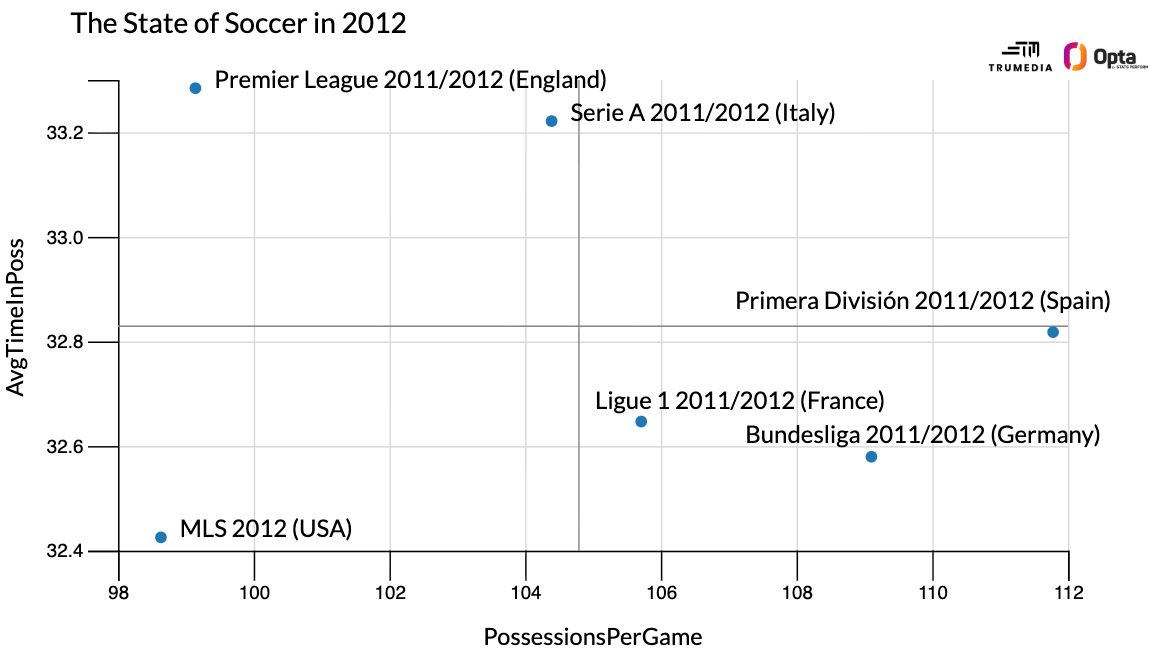
In MLS of 2012, possession was changing hands less often than in any of the Big Five top European leagues. And the ball was in play less often than in any of the Big Five leagues. There was less of the most exciting part of soccer -- transitions -- and also just less, well, soccer.
On top of that, MLS teams were also attempting fewer take-ons than any of the major European leagues, and they were pressing less aggressively than almost all of them, as measured by PPDA (passes per defensive action):
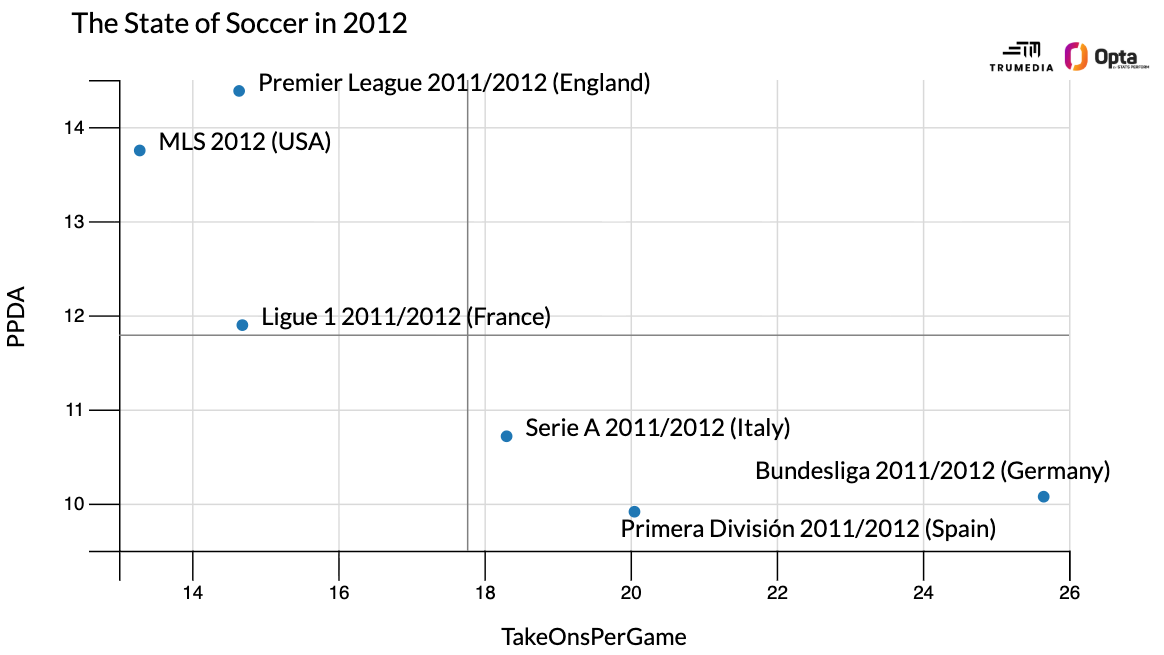
While MLS looks a little more like the Premier League and Ligue 1 there, it's important to remember that this was the modern low point for English soccer. Chelsea won the 2012 Champions League, sure, but it was one of the most improbable European Cup victories ever. Instead, Spain and Germany were the leading lights of European soccer, with Barcelona, Real Madrid, Jurgen Klopp's Borussia Dortmund and Bayern Munich defining the era.
The game at the highest level had become a blend of the two nations' tendencies: high-intensity athleticism and world-class technical precision. In 2012, MLS offered viewers neither.
What MLS looks like today
In the broadest sense, MLS has improved almost every year since 2012. The number of turnovers in the attacking third steadily increased for almost a decade before falling off slightly over the past few seasons. Still, we're way higher than where we were 13 years ago:
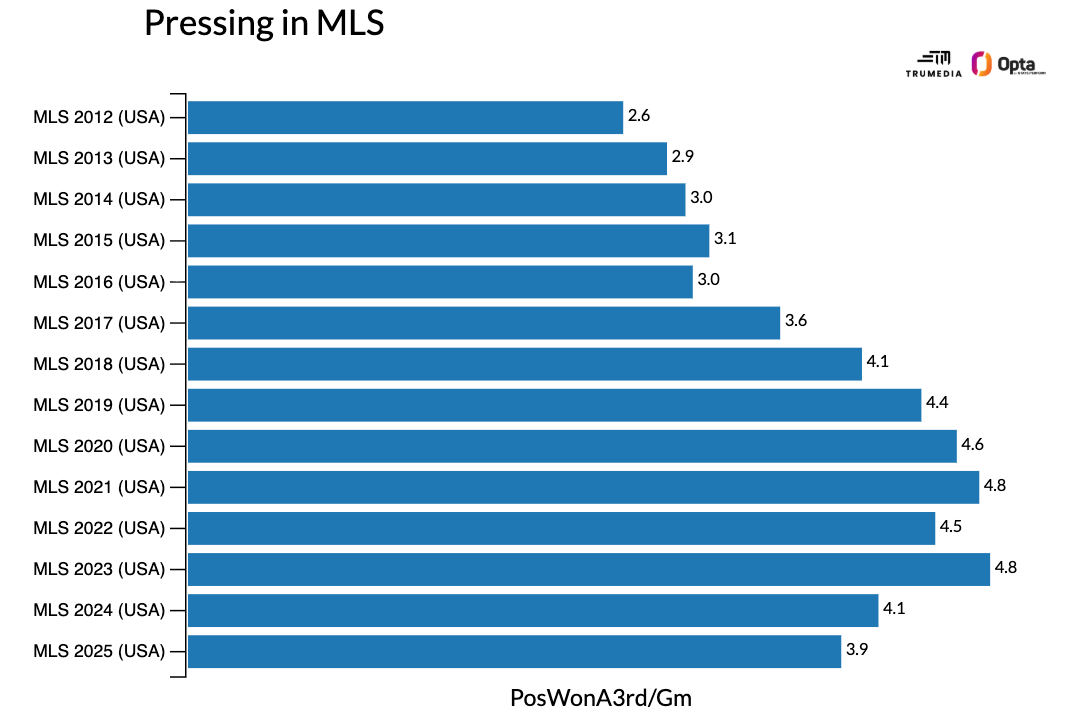
And while the rise in turnovers could also be used as an argument for worse play -- more turnovers, this argument could go, mean more sloppy passing -- that's canceled out by the league's steadily improving pass-completion rate.
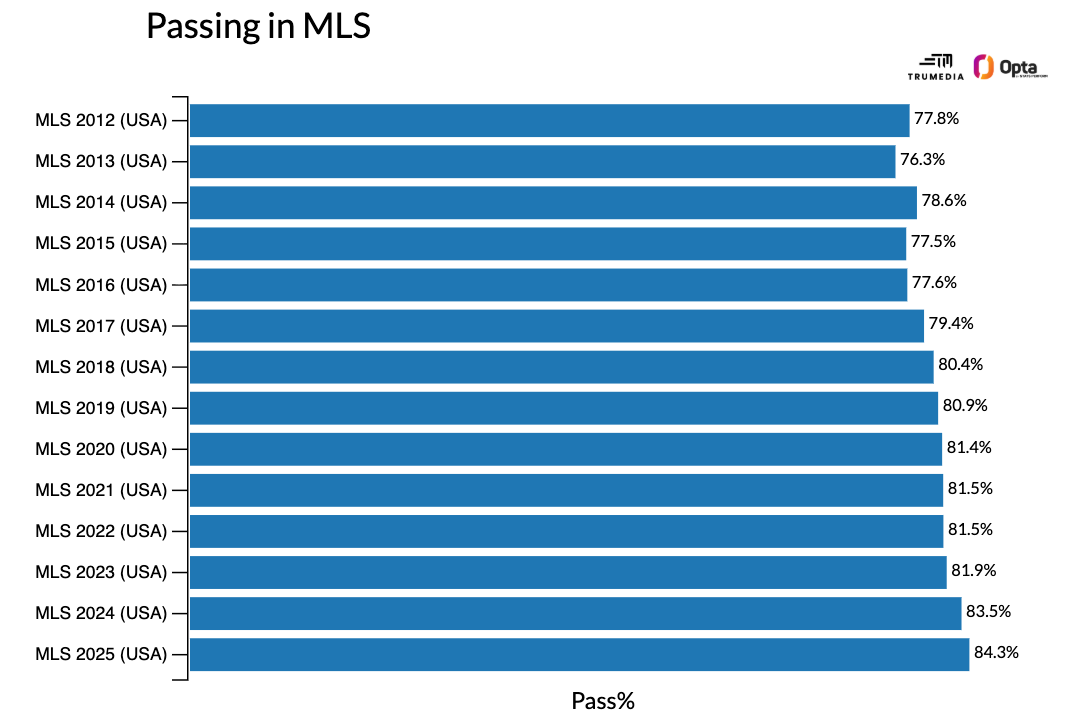
Teams winning possession in the attacking third more often and teams completing their passes more often is a healthy combination. It means clubs are taking more risks defensively than they had in the past, and clubs are able to hold up in possession against the higher-pressure defense. From a big-picture stylistic view, that's the kind of push-and-pull you want -- one where neither approach totally dominates the other -- if you want your league to be interesting to watch.
This has also coincided with a change in the type of players coming to the league. In 2020, per data from the consultancy Twenty First Group, the average transfer signing cost €4 million and had an average age north of 25. In 2025, the average signing dropped both in price (€2.4 million) and in age (24). At the same, teams generated €161 million from incoming transfer fees in 2025.
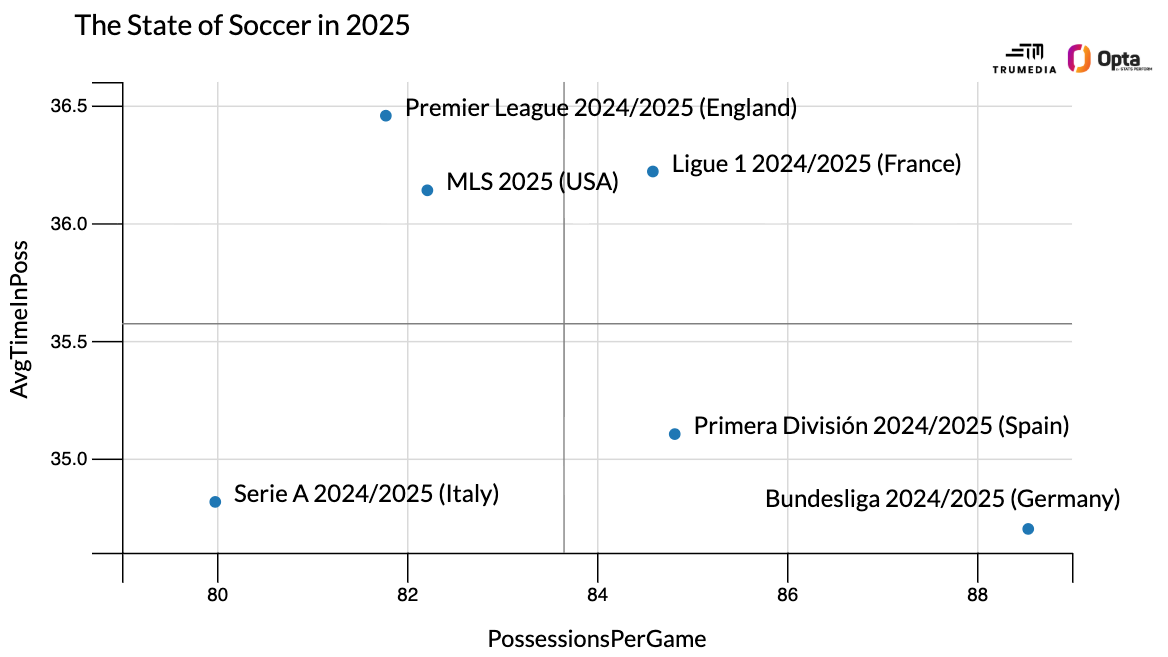
So while there are still plenty of aging headline stars, the league finally has started to position itself as a player development league, where young players can come before they move on to Europe. And thanks to a changing player pool, if we look at that same chart from earlier, but fast-forward it today, MLS is no longer the outlier slow league where possession never changes hands and the ball is never in play. No, that's Italy now:
Back in 2012, MLS also simply stood out in how its teams lined up for each match. The league's most used formation back then was the simple 4-4-2, per Stats Perform data. Across the Big Five leagues, the 4-2-3-1 was more than twice as popular as any other formation in the 2011-12 season.
This year, the 4-2-3-1 has been MLS's most popular formation, more than twice as popular as No. 2: the 4-3-3. The 4-4-2 has slipped down to third. The most popular formation across the Big Five leagues in 2024-25? Yep, still the 4-2-3-1.
Now, even though they're playing more like them, MLS teams aren't close to the quality of those European leagues still. But it's undeniable that the teams, on the whole, are much better than they were back in 2012.
Among all MLS teams since 2012, this season's Whitecaps rank in the 90th percentile or better for shots, expected goals, pull backs, touches inside the opposition box, and final-third-adjusted possession. In terms of being able to both control the ball and then use the ball to create high levels of offensive threat, there haven't been many better sides in the history of the league.
And Inter Miami? Well, they have Messi and his Barcelona buddies. That means that they, somehow, both play a smaller percentage of their passes forward than any MLS team since 2012 and they've also attempted more through balls than all but five other teams over that same span. Put more simply, they scored 98 goals this season -- 12 more than anyone else since the league began.
Sunday's MLS Cup final both manages to be a marketing dream matchup between the two best players from the 2014 World Cup final and a fascinating stylistic matchup in 2025 between two very different but equally exciting teams.
The league wasn't supposed to be able to provide the star power and genuinely interesting soccer at the same time. It was supposed to be a choice between the two: build around old guys who can't run and sacrifice the product, or build around the undervalued no-names who might give you something interesting on the field. Somehow, though, the league has both.
And somehow, no one really seems to care.